
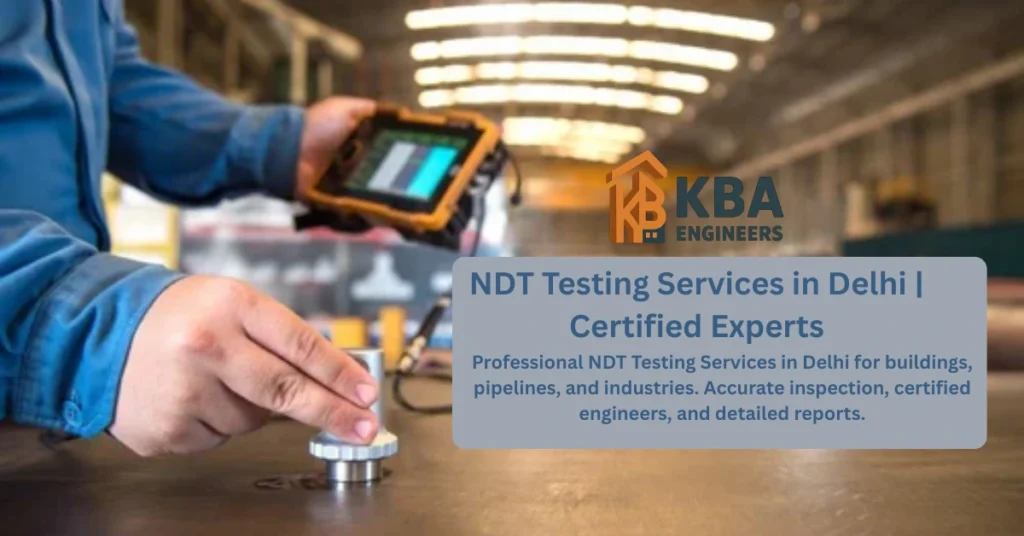
What is NDT Testing and how does it work?
If you are searching for NDT Testing Services in Delhi or looking for the Best NDT Testing Company in Delhi, this comprehensive guide will provide everything you need to know about non-destructive testing, its methods, applications, standards, process, and industry relevance. Whether you are a builder, consultant, contractor, industrial plant owner, or facility manager, understanding NDT helps you ensure structural safety, quality compliance, and long-term durability.
Non-destructive testing plays a crucial role in modern construction and industrial sectors across Delhi NCR. From residential buildings and commercial complexes to pipelines, factories, bridges, and power plants, NDT testing in Delhi has become essential for safety evaluation and regulatory compliance.
What is Non-Destructive Testing (NDT)?
Non-Destructive Testing in Delhi refers to a range of inspection techniques used to evaluate the properties of materials, components, or structures without causing damage. Unlike destructive testing, where samples are broken or altered, NDT allows engineers to assess structural integrity while keeping the asset fully operational.
The primary objective of NDT testing services is to:
- Detect cracks, voids, corrosion, and defects
- Measure strength and durability
- Evaluate structural stability
- Ensure compliance with safety standards
- Prevent unexpected failures
In a fast-growing infrastructure environment like Delhi NCR, NDT Testing Delhi NCR is increasingly important for both new constructions and old building assessments.
Why NDT Testing is Important in Delhi NCR
Delhi and surrounding regions experience:
- Aging infrastructure
- High-rise construction growth
- Industrial expansion
- Environmental exposure (pollution, moisture, temperature variations)
These factors increase the need for NDT Inspection Services Delhi to monitor structural health and avoid major failures.
Key reasons why NDT testing in Delhi is critical:
Structural audit of old buildings
Quality control in new construction
Safety verification after fire or earthquake
Industrial plant maintenance
Pipeline safety monitoring
Third-party quality inspection
Types of NDT Testing Methods Used in Delhi
A professional NDT Testing Company in Delhi typically offers multiple inspection methods depending on material type and project requirements.
Rebound Hammer Test
Used to estimate surface compressive strength of concrete. It is widely used in residential and commercial building assessments across Delhi.
Ultrasonic Pulse Velocity (UPV) Test
Measures the quality and uniformity of concrete by sending ultrasonic waves through the structure. It helps detect:
- Internal cracks
- Voids
- Honeycombing
- Poor compaction
This method is commonly used in certified NDT services in Delhi NCR for structural audits.
Core Testing
Although partially destructive, core testing validates concrete strength by extracting a cylindrical sample. It is often used alongside other NDT methods for accurate evaluation.
Magnetic Particle Testing Delhi
Magnetic Particle Testing Delhi is primarily used for detecting surface and near-surface cracks in ferromagnetic materials such as steel structures, pipelines, and industrial components. It is widely used in industrial NDT services Delhi.
Ultrasonic Testing (UT)
Commonly used in industrial sectors and pipeline NDT testing Delhi, this method detects internal flaws in metals and welds.
Radiographic Testing (RT)
Used for inspecting weld joints, pipelines, and pressure vessels. This technique is common in industrial NDT services Delhi for heavy engineering projects.
Liquid Penetrant Testing (PT)
Used to detect surface cracks in non-porous materials.
Eddy Current Testing (ECT)
Applied mainly in industrial and manufacturing sectors for detecting surface and sub-surface flaws.
Applications of NDT Testing in Delhi
Civil Engineering and Construction
Non Destructive Testing in Delhi is widely used for:
- Structural audits of old buildings
- Strength evaluation of columns, beams, and slabs
- Pre-purchase property inspection
- Post-fire structural evaluation
- Pre-retrofitting assessment
Pipeline and Oil & Gas Sector
Pipeline NDT Testing Delhi ensures:
- Leak prevention
- Weld integrity testing
- Corrosion detection
- Thickness measurement
Pipeline safety is critical in industrial zones around Delhi NCR.
Industrial Sector
Industrial NDT Services Delhi are used in:
- Manufacturing plants
- Power plants
- Refineries
- Heavy machinery inspection
- Boiler and pressure vessel inspection
Third-Party Quality Inspection
Third Party NDT Inspection in Delhi is essential when:
- Clients want unbiased quality reports
- Builders need compliance certification
- Government approvals require inspection reports
- Contractors must verify workmanship
Step-by-Step NDT Testing Process
Understanding the process helps clients evaluate the professionalism of an NDT Testing Company in Delhi.
Site Inspection and Requirement Analysis
Engineers visit the site to assess structural conditions and determine testing objectives.
Method Selection
Based on structure type, material, and defect suspicion, appropriate NDT methods are selected.
Surface Preparation
Cleaning and preparation ensure accurate readings.
Testing Execution
Tests are conducted using calibrated instruments under controlled procedures.
Data Analysis
Collected data is analyzed by experienced engineers to interpret structural conditions.
Detailed Reporting
Certified NDT Services in Delhi NCR provide detailed reports including:
- Observations
- Test readings
- Graphs and images
- Structural condition assessment
- Recommendations
NDT Testing Standards Followed in India
Professional NDT Testing Delhi NCR companies follow Indian and international standards such as:
- IS 13311 (Ultrasonic Pulse Velocity Test)
- IS 516 (Concrete Strength Testing)
- IS 456 (Plain and Reinforced Concrete Code)
- ASTM standards
- ASME standards
- ISO guidelines
Compliance ensures credibility and acceptance by regulatory authorities.
Cost Factors of NDT Testing in Delhi
If someone searches for “ndt testing in delhi near me” or “ndt testing services in delhi near me,” cost is usually a major consideration.
The cost of ndt testing services depends on:
- Type of test required
- Structure size
- Number of test points
- Accessibility conditions
- Urgency of inspection
- Equipment used
- Reporting complexity
Industrial NDT Services Delhi and Pipeline NDT Testing Delhi may have higher costs due to advanced equipment and safety measures.
Advantages of NDT Testing
No structural damage
Cost-effective compared to reconstruction
Early defect detection
Improved safety
Compliance with regulations
Extended service life of structures
Reduced maintenance cost
Limitations of NDT Testing
While NDT is highly effective, it has limitations:
- Requires skilled technicians
- Advanced equipment can be costly
- Interpretation depends on expertise
- Some hidden defects may require multiple testing methods
This is why selecting the Best NDT Testing Company in Delhi becomes important.
What Makes a Reliable NDT Testing Company in Delhi
When choosing NDT Testing Services in Delhi, consider:
- Certified and experienced engineers
- Calibrated and modern equipment
- Compliance with IS/ASTM standards
- Transparent reporting
- On-site testing capability
- Experience in both civil and industrial projects
- Capability for Third Party NDT Inspection in Delhi
NDT Testing for Old Buildings in Delhi
Many structures in Delhi are over 20–30 years old. Structural deterioration due to corrosion, moisture, pollution, and overloading is common. NDT Testing in Delhi helps determine:
- Remaining strength of concrete
- Steel reinforcement condition
- Crack depth and severity
- Load-bearing capacity
This data is essential before renovation, retrofitting, or redevelopment.
NDT Testing for Industrial Plants in Delhi NCR
Industrial NDT Services Delhi are critical in preventing accidents in:
- Chemical plants
- Manufacturing units
- Thermal plants
- Storage tanks
- Pipelines
Pipeline NDT Testing Delhi ensures continuous operation and prevents environmental hazards.
Role of Certified NDT Services in Delhi NCR in Structural Audits
Structural audits are now mandatory in many commercial and high-rise buildings. Certified NDT Services in Delhi NCR provide technical evaluation that includes:
- Concrete quality testing
- Reinforcement detection
- Corrosion mapping
- Structural stability assessment
Such reports are essential for:
- Insurance approvals
- Government compliance
- Safety certification
Comprehensive Civil Construction and Structural Solutions in Delhi
Choosing the right civil construction company in Delhi is essential for ensuring quality workmanship, structural durability, and long-term safety. From residential homes and commercial complexes to industrial facilities, professional construction planning and execution directly impact the performance and lifespan of any structure. Reliable engineering practices, quality materials, and strict compliance with building codes are key elements that define successful projects.
In addition to new developments, expert building construction services in Delhi also include renovation, expansion, project management, and turnkey solutions tailored to client requirements. Every stage from design coordination to final execution must be handled with precision to maintain structural integrity and cost efficiency.
Over time, buildings may experience deterioration due to environmental exposure, aging, or structural stress. In such cases, specialized Structural repair services in Delhi become crucial to restore strength and stability. Advanced repair techniques, retrofitting solutions, and technical assessments ensure that structures remain safe, compliant, and capable of serving their intended purpose for years to come.
Conclusion
Non-Destructive Testing is a critical tool for ensuring structural safety, quality assurance, and long-term durability in both civil and industrial projects. By detecting internal defects, material weaknesses, and potential risks without damaging the structure, NDT supports informed decision-making and preventive maintenance. In a growing region like Delhi NCR, where infrastructure development and aging buildings coexist, professional testing services play an essential role in maintaining safety standards and regulatory compliance.
Accurate testing depends on skilled professionals, proper methodology, and adherence to recognized standards. Whether it involves structural audits, industrial inspections, or third-party quality verification, reliable NDT services help minimize risks and reduce future repair costs.
At kbaengineers, the focus is on delivering precise, standards-compliant inspection solutions tailored to project needs. With technical expertise and a commitment to quality, the objective is to provide dependable assessments that ensure structural integrity and long-term performance.
Frequently Asked Questions (FAQs)
How do I know which NDT method is suitable for my project?
The selection of an NDT method depends on the type of material, suspected defect, accessibility, and project objective. For example, concrete structures may require strength and uniformity evaluation methods, while steel welds may need crack detection techniques. A professional assessment helps determine the most accurate and cost-effective approach.
Can NDT testing be performed on an occupied building?
Yes, most NDT methods can be conducted in occupied buildings without disturbing residents or operations. Since the techniques are non-destructive and minimally invasive, they are suitable for residential societies, commercial complexes, hospitals, and offices.
How accurate are NDT results compared to laboratory testing?
NDT provides highly reliable results when conducted using calibrated instruments and experienced engineers. While some laboratory-based tests may offer precise numerical values, NDT delivers strong indicative data that is sufficient for most structural evaluations, audits, and safety decisions.
Is NDT testing required before property purchase?
Many buyers and investors now prefer structural health assessments before purchasing old or high-value properties. NDT helps identify hidden structural weaknesses, giving buyers confidence and preventing unexpected repair expenses after purchase.
Can NDT detect corrosion inside reinforced concrete?
Yes, specialized NDT techniques can assess reinforcement condition, detect corrosion activity, and estimate deterioration levels within concrete structures without breaking large portions of the surface.
How often should industrial equipment undergo NDT inspection?
Inspection frequency depends on regulatory guidelines, operating conditions, and risk level. High-pressure systems, heavy-load machinery, and critical infrastructure typically require periodic inspection at defined intervals to maintain safety and compliance.
Does NDT testing require electricity shutdown or plant stoppage?
In many cases, NDT can be performed without complete shutdown. However, certain industrial inspections may require temporary isolation for safety reasons. Planning and coordination minimize operational disruption.
What qualifications should NDT technicians have?
Technicians should hold recognized certifications under national or international qualification systems and have hands-on field experience. Proper certification ensures accurate testing procedures and reliable interpretation of results.
Can NDT help in planning structural retrofitting?
Yes, NDT plays a critical role in retrofitting projects. It identifies weak zones, determines material strength, and provides technical data necessary for designing strengthening measures.
Are NDT reports legally valid for compliance and approvals?
When performed by qualified professionals following recognized standards, NDT reports are generally accepted by consultants, regulatory bodies, insurance companies, and project authorities as part of structural safety documentation.